Banking Failure Contagion Modeling for Corporate Strategy Teams
The 2023 Silicon Valley Bank collapse took 48 hours from first signals to FDIC receivership. The 2008 financial crisis took 18 months from the first significant bank failures to the systemic freeze. That's not just a difference in speed. It's a difference in the mechanism of contagion, and corporate treasury teams that are still modeling banking risk on 2008 frameworks are modeling the wrong event.
The Academic Toolkit: DebtRank and Threshold Models
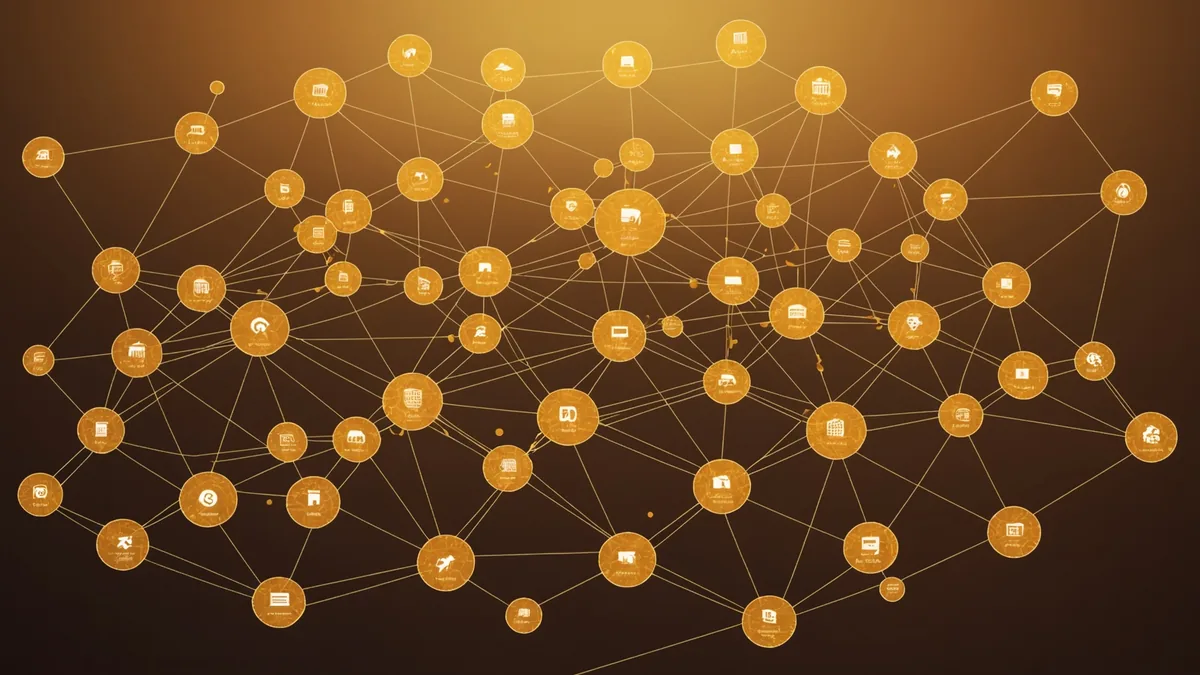
Network contagion models formalize something that banking regulators have known qualitatively for decades: the financial system is a network of obligations, and the failure of one node imposes losses on its counterparties, which may push those counterparties toward failure, propagating through the network in waves.
DebtRank, developed by researchers at the Santa Fe Institute and later adopted by the European Central Bank for systemic risk analysis, quantifies this propagation. Each institution has an equity buffer. Counterparty losses eat into that buffer. When the buffer is exhausted, the institution becomes a source of additional losses for its own creditors and counterparties. The model traces this chain across the network, producing a systemic impact score for each institution that accounts for its position in the network, not just its individual exposure level.
Threshold models take a different approach. Rather than modeling continuous loss propagation, they model binary failures: each institution fails or it doesn't, based on whether aggregate losses from connected failures exceed a threshold. These models are simpler computationally but capture a real phenomenon: in practice, institutional failures are often discrete events triggered by confidence thresholds rather than pure accounting losses.
Both frameworks are useful for academic stress testing. Their direct application to corporate treasury strategy has historically been limited by data availability. You need the interbank exposure matrix to run DebtRank, and that data isn't publicly disclosed at the institution level.
SVB 2023 vs. Lehman 2008: A Structural Comparison
Here's what changed. The SVB contagion was not primarily a counterparty network effect. It was an information contagion, amplified by three structural factors that didn't exist in 2008 in the same form.
| Factor | 2008 (Lehman) | 2023 (SVB) |
|---|---|---|
| Contagion speed | Weeks to months | Hours to days |
| Primary mechanism | Counterparty credit exposure | Depositor coordination via social media |
| Amplification channel | Interbank lending freeze | Twitter + Slack + VC network signaling |
| Uninsured deposit share | Lower (diversified retail base) | 93% uninsured at SVB |
| Regulatory response time | Days to weeks | Weekend (FDIC moved by Monday) |
The 93% uninsured deposit concentration is the structural vulnerability that made SVB susceptible to information-driven contagion. When deposits are primarily institutional and uninsured, the rational response to any credible signal of bank stress is immediate withdrawal. No coordination problem needs solving. The VC network solved it in a weekend.
In our analysis of the SVB timeline, the critical signal wasn't the HTM portfolio disclosure. It was the Founders Fund recommendation to withdraw deposits on the afternoon of March 8. From that signal to FDIC receivership was less than 36 hours. No 2008-era contagion model runs at that speed because no 2008-era contagion model had a social-media coordination layer.
What Corporate Treasury Teams Can Actually Simulate
The question for non-financial corporations isn't whether they can replicate a systemic stress test. They can't. But there are specific banking-exposure scenarios that corporate treasury teams should be modeling, and the tools exist to do it.
Concentration risk is the starting point. How much of your operating cash, payroll float, and short-term investments sits with a single banking relationship? The SVB event was a direct wake-up call for the startup ecosystem, where cash concentration above $250k at a single institution had been standard practice. But the same concentration risk exists in mid-market corporates, and most treasury teams can't tell you their own exposure distribution without pulling data from multiple systems.
Counterparty network modeling, even without the full interbank matrix, is possible for corporate exposures. Map your cash management banks, your trade finance relationships, and your hedging counterparties. Identify which institutions are concentrated in the same asset classes or depositor profiles. Run a threshold model: if Institution A comes under stress, what does the network graph of your banking relationships look like after first-order contagion effects?
Social media signal monitoring deserves its own thread. The SVB event was detectable from open-source signals 24 to 48 hours before FDIC seizure. Twitter keyword velocity, VC community Slack chatter that leaked to public channels, the tone shift in founder Twitter threads about banking relationships. Corporate treasury teams with intelligence aggregation tools can monitor for these signals as early warning indicators for institutions with high uninsured deposit concentrations.
The Limitations of Current Regulatory Stress Tests
Real talk: the Federal Reserve's annual stress tests, the CCAR (Capital Analysis and Review) process, are well-designed for the crisis they're designed to prevent, which is the 2008 crisis. They test credit losses under adverse macroeconomic scenarios. They model counterparty exposure. They assume contagion propagates through balance-sheet channels over weeks and months.
They do not model speed. They do not model information contagion through social networks. They do not model depositor coordination dynamics. And crucially, they apply only to banks above $100 billion in assets, specifically excluding the mid-size regional banks where the 2023 stress was concentrated.
The Basel III/IV capital and liquidity requirements are similarly calibrated to 2008-style credit crises. The Net Stable Funding Ratio and Liquidity Coverage Ratio were designed to ensure institutions can survive 30 days of stressed outflows. SVB was seized in 2 days. The regulatory framework, by design, didn't address that scenario.
This isn't a critique of regulators. It's a calibration note for corporate strategy teams: don't mistake regulatory compliance for stress resilience. The stress test passing grade tells you what the regulator is measuring. It doesn't tell you what the next crisis will look like.
Building a Practical Contagion Scenario
For corporate treasury teams that want to build a banking stress scenario, here's a starting structure:
- Map your banking exposure network. List every institutional relationship: primary operating account bank, secondary banks, trade finance providers, FX hedging counterparties, money market fund managers. For each, record: institution name, uninsured deposit concentration, asset class mix (heavy in HTM bonds? concentrated in one sector?), and your exposure amount.
- Identify your trigger institutions. Which institutions on your list share structural characteristics with SVB? High uninsured deposit share above 70%, heavy duration mismatch between assets and liabilities, concentrated depositor base in a single industry or geography.
- Model the information cascade. If a credible signal of stress emerges at your trigger institution, what is the timeline to potential action? Include the social media signal velocity factor: how fast does information propagate in the institutional network around this bank?
- Quantify your 48-hour exposure. If your primary operating bank were seized on a Wednesday, what is the maximum operating disruption before alternative banking relationships could be activated? This is the number that matters for business continuity planning.
We've run this exercise with treasury teams across multiple sectors, and the results are consistently more concentrated than the teams expected before mapping. The average corporate treasury team in our experience has over 60% of its operating cash at a single primary institution, with no documented activation plan for alternatives.
Principle helps corporate strategy and treasury teams model financial system stress scenarios. See how the platform works or talk to us.