Scenario Simulation vs. Traditional Risk Models: A Structural Comparison

We've spent years watching enterprise risk teams run the same playbook: build a probability-impact matrix, assign likelihood scores, maybe layer in a Value-at-Risk model calibrated to the last decade of returns. Then a genuine tail event hits, and the model offers nothing useful. Not because the people were careless. Because the model structure itself was the problem.
What Traditional Risk Models Actually Do
Traditional risk frameworks fall into roughly three families. Probability-impact matrices assign a likelihood score and a severity score to each identified risk, multiply them, and rank by the product. They're intuitive and fast to build. They're also static snapshots that can't capture how one event triggers the next.
Value-at-Risk (VaR) was the quantitative upgrade. At a 99% confidence level, VaR tells you the maximum loss you should expect on a typical bad day. Banks embraced it. Regulators institutionalized it. The 2008 crisis demonstrated its fatal flaw: it's a statistical description of the distribution tail, not a model of what happens inside the tail. When correlations break down and assets that historically moved independently start moving together, VaR gives you a number that's technically correct under assumptions that no longer hold.
Monte Carlo simulation was supposed to fix this. Feed it enough historical data, run 10,000 random paths, and you get a distribution of outcomes. The catch is what's baked into those random paths: the same historical correlations, the same regime assumptions, the same distribution shapes. Run Monte Carlo on 2006 housing data to simulate 2007. You won't get the financial crisis. You'll get a comfortable range around the trend.
The Fundamental Problem: Correlation Is Not Mechanism
Here's the structural issue. Traditional quantitative models are trained to describe what has happened, then extrapolate. They learn that Variable A and Variable B move together 78% of the time. They don't learn why. They don't model the chain of causation that produces the correlation.
This works acceptably in normal conditions, where the underlying mechanisms are stable. It fails catastrophically at tail events, which are tail events precisely because the mechanisms change. A new regulatory regime. A technology discontinuity. A geopolitical shock that rewrites supply-chain economics. These events don't look like the past. They're not supposed to.
In our experience, most senior risk officers know this intuitively. They've seen their models fail. They keep using them because the alternatives have historically been worse: qualitative scenario narratives that can't be stress-tested, consultant workshops that produce strategic-planning decks with no quantitative backbone.
How Causal Simulation Differs
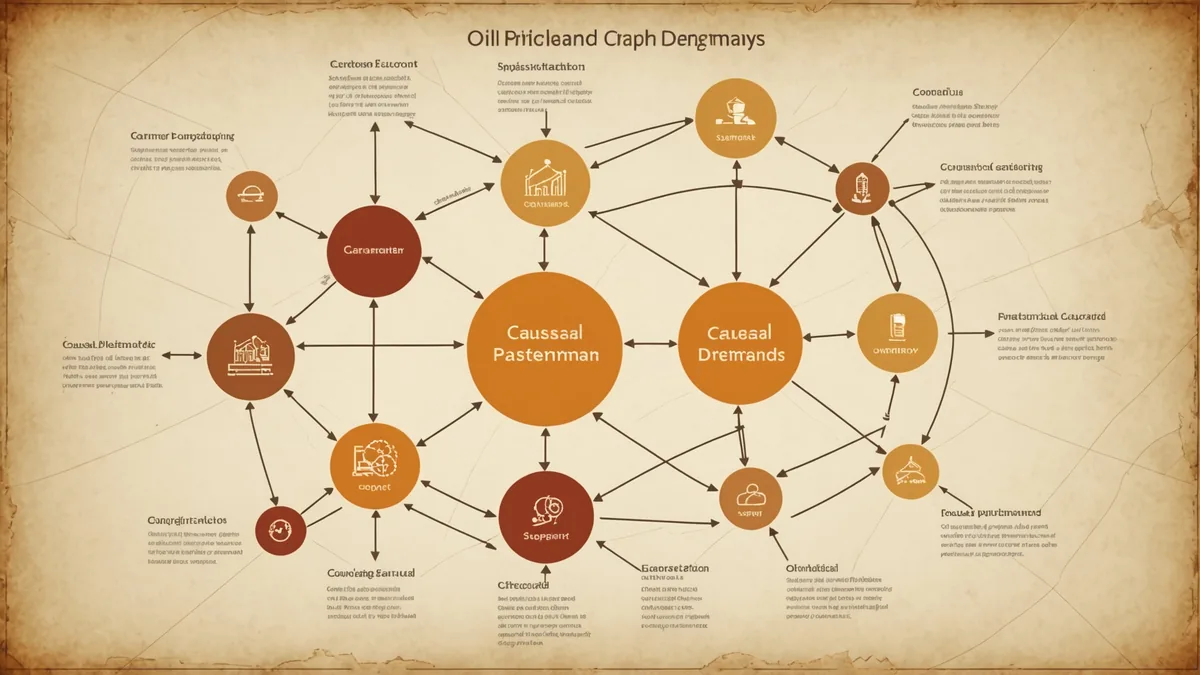
Causal graph-based simulation takes a different starting point. Rather than asking "what has happened," it asks "what mechanisms govern this system." You build a directed acyclic graph of causal relationships: not correlations, but explicit cause-and-effect links with direction and estimated strength.
The advantage is structural. When an input changes, the model propagates effects through the mechanism graph, not through historical correlations. You can introduce genuinely novel shocks, changes that have no historical analog, and the model will trace their downstream effects as long as the underlying mechanisms are correctly specified.
This matters for a specific class of risks: those involving policy shifts, geopolitical restructuring, and technology discontinuities. All three share the property that correlation-based models are blind to them until they've already happened.
The Tariff Shock of 2025: A Case Study in Second-Order Effects
Consider the tariff escalation cycle of 2025. Most quantitative trade models had some version of "tariff increase reduces imports" in their structure. That first-order effect was correctly anticipated.
What wasn't modeled: the second and third-order effects that actually mattered to corporate strategy teams. A 25% tariff on intermediate goods from key manufacturing regions didn't just raise input costs. It triggered a parallel shift in procurement strategy across hundreds of multinationals simultaneously. That simultaneous shift created a 6-to-9-month demand spike in alternative supplier regions, which surfaced capacity constraints that hadn't existed before the shock. Those capacity constraints then delayed the realization of cost savings that companies had already built into their 2025 margin guidance.
Correlation models couldn't see this coming. Not one of them. A causal simulation approach that modeled the procurement decision logic, the capacity curves in alternative supplier regions, and the timing dependencies between decisions would have surfaced the capacity constraint scenario as a primary risk path, not a tail note.
The difference isn't academic. Companies that anticipated the capacity constraint cycle adjusted their procurement timelines and hedged differently. Companies relying on VaR and static scenario matrices were still running their original guidance when the bottlenecks materialized.
When to Use Which Approach
We're not arguing traditional models should be discarded. They have genuine utility.
| Method | Best For | Blind Spot |
|---|---|---|
| Probability-Impact Matrix | Rapid risk inventory, stakeholder communication | No interaction effects, static |
| VaR / CVaR | Portfolio risk reporting, regulatory compliance | Fails at tail, assumes stable correlations |
| Historical Monte Carlo | Stress-testing within historical regimes | Cannot model novel mechanism changes |
| Causal Graph Simulation | Novel shocks, policy shifts, geopolitical scenarios | Requires explicit mechanism specification |
The honest answer is that the two approaches are complements. Use quantitative models for the continuous monitoring layer, for the day-to-day risk reporting function. Use causal simulation for the strategic question: what happens when the regime changes, when a shock introduces a mechanism that has no historical precedent.
The Specification Problem
Causal simulation has its own failure mode. Worth naming it directly.
If your causal graph misspecifies a mechanism, the model confidently propagates the wrong effects. A correlation model that fails at a tail event at least fails quietly. A causal model with a structural error fails loudly, in a way that looks authoritative. This is why the quality of the mechanism library matters as much as the simulation engine itself.
What we've found after building these models across dozens of enterprise scenarios: the specification process is often more valuable than the output. When strategy teams sit down to build causal graphs, they're forced to articulate, precisely, what mechanisms they believe govern their competitive environment. That forced articulation surfaces disagreements that would otherwise live in unstated assumptions. The model becomes a structured argument, not just a forecast.
The question isn't whether to model risk. The question is whether your model structure matches the type of risk you actually face. For tail events and novel shocks, mechanism matters more than history.
Traditional risk models aren't going away. But the strategic decisions that matter most, those made in the 6 months before a genuine regime change, require a different kind of analysis. That's the gap causal simulation is designed to fill.
See how Principle builds causal scenario models for enterprise strategy teams. Explore the Platform or request a demo.