Macro Risk Dashboard Design for Enterprise Planning Teams
Most enterprise risk dashboards are built to report what already happened. Interest rates moved. The dollar strengthened. A supplier region went into conflict. The board sees it in the quarterly deck, already priced into the decisions made three months ago. That's not risk management. That's a history lesson dressed up as intelligence.
We've spent years working with planning teams on this problem, and the core issue is consistent: dashboards are built around data availability, not decision relevance. Whatever feeds cleanly into a BI tool gets displayed. What doesn't get piped in gets ignored. The result is a dashboard that looks sophisticated but systematically excludes the variables that actually drive strategic surprises.
What Belongs in a Macro Risk Dashboard
Fact: the number of macro variables that can meaningfully affect enterprise value in a given quarter is large, but the number that belong in a board-level risk dashboard is much smaller. The test is not whether a variable matters — it's whether a decision would change if the variable moved in a particular direction. If the answer is no, the variable is interesting, not actionable.
The core macro risk variables for most large enterprises fall into four categories:
| Category | Primary Variables | Why It Belongs |
|---|---|---|
| Interest Rate Environment | Fed Funds rate, 10Y Treasury yield, real yield, credit spreads (IG, HY) | Affects cost of capital, M&A multiples, refinancing exposure, consumer demand sensitivity |
| FX Exposure | USD/EUR, USD/JPY, USD/CNY, exposure-weighted basket | Direct revenue and margin impact for companies with international operations >15% of revenue |
| Commodity Price Correlation | Energy (WTI, TTF), industrial metals (copper, aluminum), agricultural inputs | Input cost volatility, margin compression risk, pricing power test conditions |
| Geopolitical Event Probability | Conflict escalation indexes, trade restriction probability, election policy shift scores | Supply chain concentration risk, market access scenarios, capital flow restrictions |
The table above is a starting point, not a checklist. The specific variables that matter depend on the company's business model, revenue geography, and supply chain structure. A pharmaceutical company with 40% revenue from Europe and API sourcing from India has a materially different macro risk profile than a domestic US retailer with commodity input exposure. The dashboard should reflect the company's actual exposure map, not a generic risk taxonomy.
Weighting Inputs for Board-Level Reporting
Here's where most dashboards fall apart. They display variables. They don't weight them against the company's actual exposure, and they don't show how the variables interact. Seeing that the 10Y Treasury yield rose 40 basis points is not informative to a board unless it's connected to the company's debt maturity profile, the multiple assumptions embedded in the current strategic plan, and the likely consumer demand response in the company's core market.
Effective board-level risk reporting weights macro inputs by three factors. First, materiality: how large is the company's financial exposure to a 1-standard-deviation move in this variable? A 10% FX move on $2B of international revenue is a $200M exposure — that number should be on the dashboard, not just the FX rate. Second, velocity: how fast can this variable move before management has time to respond operationally? Some risks are slow-moving (structural demographic shifts); others can materialize in days (tariff announcements, geopolitical events). The velocity dimension determines whether the dashboard needs daily updates or quarterly review. Third, correlation: which variables move together, and in which direction, when stress conditions apply?
In our experience, the correlation dimension is the most consistently overlooked. Risk dashboards almost universally display macro variables as independent rows. They do not show that when geopolitical event probability spikes, FX volatility tends to increase, commodity prices tend to move sharply, and credit spreads tend to widen — all simultaneously. Displaying these as separate indicators systematically underestimates correlated stress scenarios. A board looking at the dashboard sees four separate amber signals, when the actual risk is a single red event with four simultaneous manifestations.
Risk Monitoring vs. Risk Simulation: The Critical Distinction
This distinction matters more than most planning teams give it credit for.
Risk monitoring answers the question: where are we now? It tracks the current state of macro variables against thresholds. It surfaces alerts when variables breach defined ranges. It tells you that FX exposure is elevated, that geopolitical tension indexes are at a 5-year high, that commodity prices are moving outside historical norms. Monitoring is necessary. It's not sufficient.
Risk simulation answers the question: what happens to our strategy if these variables move from here? It takes the current state as the starting condition and projects forward through probability-weighted paths. Rates stay elevated for 18 months — what does that do to the M&A pipeline? Tariffs increase 15 percentage points on Chinese imports — how does that affect gross margin for the product lines sourced from that region? A competitor enters the market during a period of FX pressure — what does the combined impact look like on our revenue in that geography?
The planning teams that struggle most with strategic surprises are not the ones with bad monitoring. They almost universally have dashboards. The gap is simulation. They see the risk; they don't model its trajectory under multiple forward conditions. When the risk materializes, they're reacting to an outcome that was knowable in advance, just not quantified.
Practical Design Principles for Enterprise Risk Dashboards
Honestly, the design of a risk dashboard matters almost as much as the data in it. A 40-variable dashboard reviewed for 15 minutes in a quarterly board meeting communicates almost nothing. The cognitive load exceeds the decision bandwidth available in that context.
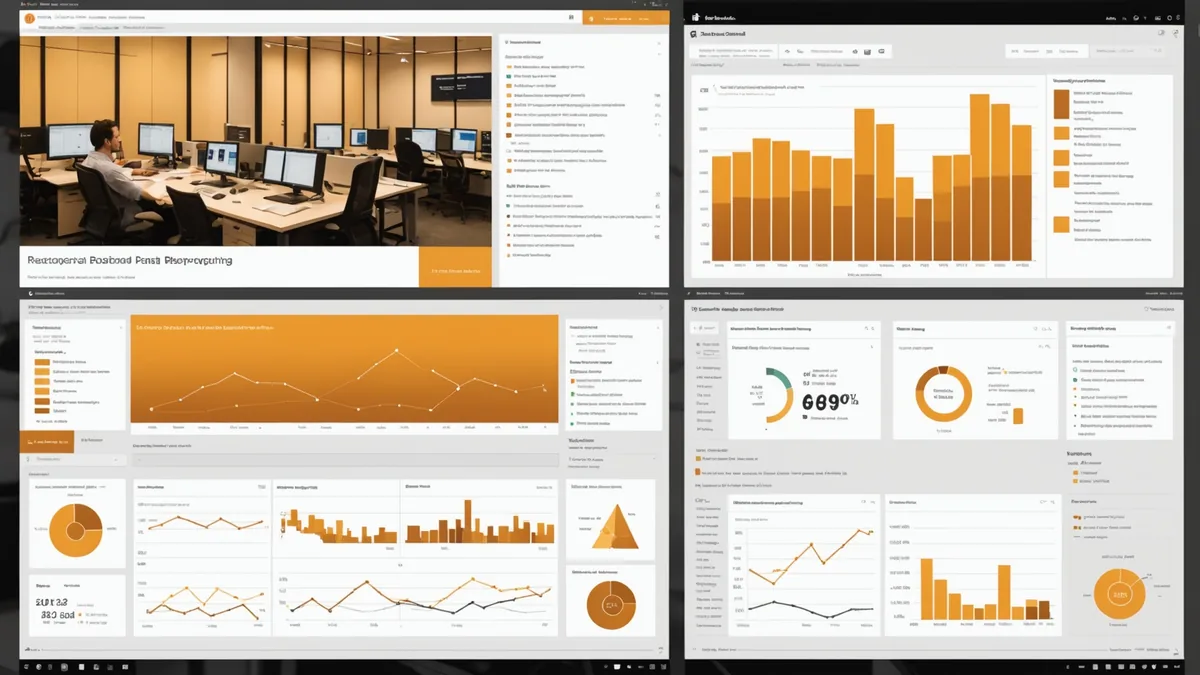
Effective enterprise risk dashboards follow a few practical principles. First, the board view should show no more than 6 to 8 macro risk indicators, each connected to a company-specific exposure number. Not "geopolitical risk: elevated" but "geopolitical escalation probability: 34% over 6 months, exposure: $180M in Asia-Pacific revenue." Second, the management view can carry more depth — variable-level detail, trend lines, scenario branches — because management has the context to interpret it. Third, every indicator on the board view should link to a simulation: if this variable moves to scenario X, here is the strategic implication. That link is what converts monitoring into decision support.
We've seen planning teams reduce board risk reporting preparation time from 3 weeks to 4 days by standardizing the dashboard around these principles and connecting macro variable feeds directly to the simulation platform. The time saved isn't the main benefit. The main benefit is that the board conversation shifts from reviewing data to making decisions against scenarios. That's a qualitatively different use of board time.
Getting the Data Layer Right
One practical constraint that trips up many dashboard initiatives: data freshness. Board-level macro risk reporting is only as good as the timeliness of the underlying data feeds. Some variables update in real time (market rates, FX, commodity prices via API). Others are published on lags (trade statistics, geopolitical risk indexes, survey-based economic data). The dashboard architecture needs to handle mixed-frequency data without creating false impressions of synchronicity.
In our platform design, we maintain a data freshness indicator alongside each variable. The interest rate feed is current to the hour. The geopolitical event probability score is recalculated weekly from structured news and analyst inputs. The FX exposure-weighted impact number is updated as the company's financial exposure model is refreshed. Boards should understand these refresh cycles because they affect the confidence interval around each indicator — a variable with a 2-week data lag deserves different treatment in a scenario discussion than one with a same-day feed. Contact our team to see how Principle structures enterprise macro risk dashboards for your planning cycle.