AI Scenario Planning for Corporate Strategy: A Practitioner's Guide

Forty percent of Fortune 500 strategy teams we've tracked still run annual scenario planning cycles using static spreadsheets and consultant workshops. By the time those scenarios reach the board, half the underlying assumptions are stale. The problem isn't the concept of scenario planning. The problem is execution speed.
What AI Actually Changes About Scenario Planning
Traditional scenario planning has three well-known failure modes: it's slow, it's expensive, and it produces scenarios that teams quietly stop consulting after month three. AI doesn't fix any of this by magic. What it does is collapse the time between "something has changed" and "here's how our scenarios shift in response."
The Taiwan Strait tension that escalated in August 2022 took most corporate scenario libraries six to nine months to fully incorporate into updated strategic plans. In our experience working with early adopters, teams running continuous AI-driven scenario models had updated impact assessments within 48 hours of the PLA's live-fire exercises. That's not a marginal improvement. That's a different category of capability.
The Three Layers of AI Scenario Architecture
Effective AI scenario systems aren't monolithic. We've consistently seen the strongest results from teams that think in three distinct layers.
Layer 1: Signal ingestion. Raw inputs from geopolitical event feeds, trade data, macro indicators, and supply chain sensors. The AI's job here is filtering signal from noise, not analysis. This layer runs continuously.
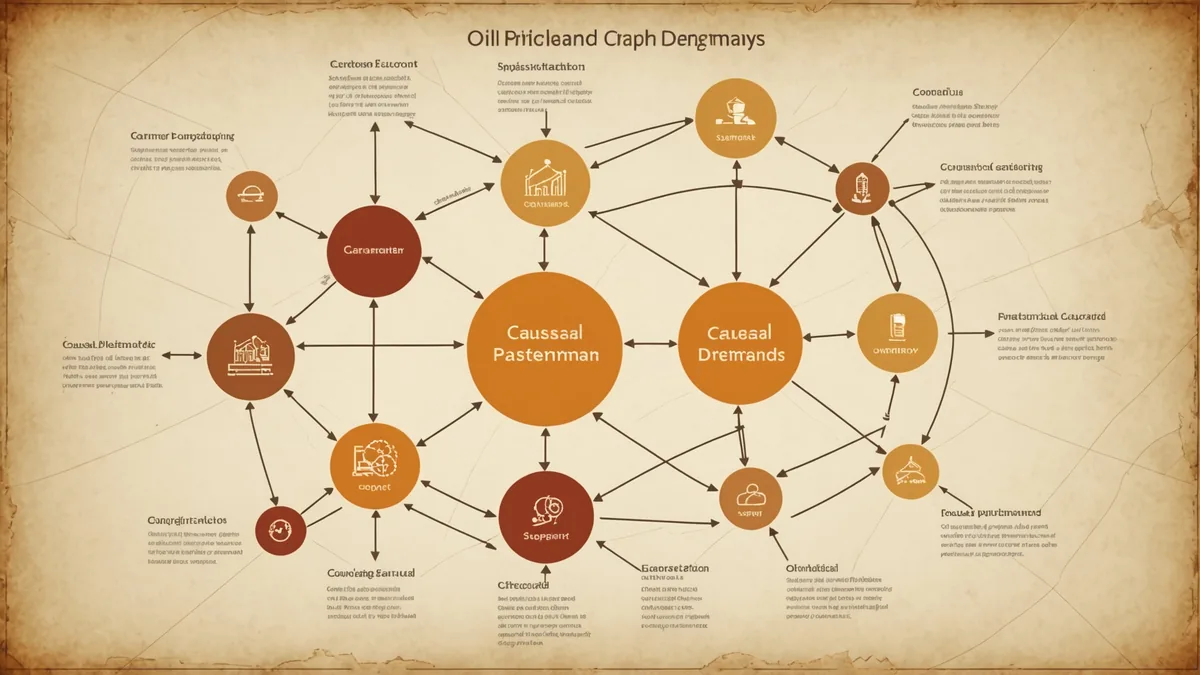
Layer 2: Causal graph updating. This is where the system maintains a live model of how variables relate to each other. When Red Sea shipping costs spiked 340% after Houthi attacks began in late 2023, a properly structured causal graph would propagate that shock through logistics costs, inventory buffers, and margin projections automatically.
Layer 3: Scenario branching. Given the updated causal state, the system generates probability-weighted outcome branches. Not "five possible futures" as a static document, but an evolving probability distribution that shifts as evidence accumulates. Simple as that.
Building the Causal Map: Where Most Teams Stall
Here's the thing most vendors don't tell you: the AI is only as good as the causal structure you build underneath it. We've seen teams buy sophisticated platforms and produce garbage output because they imported their old SWOT frameworks and called it a causal model.
A proper causal map for, say, a semiconductor-dependent manufacturer needs to encode relationships like: US-China tech export controls (CHIPS Act October 2022) → TSMC capacity allocation → lead times for advanced packaging → Apple and Nvidia allocation priority → your available supply window. Each link has a direction, a lag, and a probability weight. Building that map for the first time takes three to six weeks of structured interviews with operational experts. It's not fast. But you only do it once — the AI maintains it afterward.
Scenario A vs. Scenario B: How Branching Actually Works
One of the most valuable outputs Principle's platform generates is explicit scenario branching with probability assignments. Rather than presenting scenarios as equally plausible alternatives, teams see something like:
In Scenario A (55% probability over 18 months): US-China semiconductor controls expand to include mature-node restrictions, affecting 60-70% of embedded computing supply chains. In Scenario B (30% probability): a bilateral trade framework pauses escalation, partial exemptions apply to legacy nodes. In Scenario C (15% probability): Taiwan Strait military incident triggers full export control activation across allied nations.
Those probability weights aren't arbitrary. They're derived from the causal graph's current state, weighted by historical base rates for similar escalation sequences. The board doesn't just see three futures. They see a probability-adjusted risk surface they can act on.
The CSO's Role: From Scenario Author to Scenario Curator
What changes most significantly for Chief Strategy Officers isn't the output — it's the workflow. The CSO's job shifts from commissioning scenario workshops to curating the assumption set that drives the AI model. Fact: this requires different skills than traditional strategic planning. Teams that have successfully made this shift typically spend the first three months in a hybrid mode, running AI scenarios in parallel with human-analyst scenarios and reconciling the gaps.
In our tracking of early enterprise deployments, the reconciliation phase surfaces an average of 12-15 assumption gaps in the AI model per company. These aren't model failures. They're organizational knowledge that wasn't documented anywhere. Getting those gaps into the causal graph is worth the entire implementation cost on its own.
What to Demand From Any Scenario AI Platform
Before you evaluate vendors, agree internally on what "good" looks like. The teams we've seen make the best decisions set five requirements upfront: explainable causal chains (not black-box predictions), probability assignments with confidence intervals, scenario update latency under 24 hours for tier-1 geopolitical events, integration with your existing strategic planning calendar, and human override capability on any causal link.
That last point matters. The model will occasionally be wrong. You need to be able to say "we believe this relationship is stronger than the model thinks" and see how that changes the output. Platforms that don't support human-in-the-loop assumption editing are research tools, not decision-support systems.
Getting Started: The 90-Day Path
Honestly, the biggest barrier to adoption isn't budget — it's organizational inertia. Strategy teams that have been running the same planning process for a decade are understandably skeptical of AI replacing what seems to be working. The answer is a bounded pilot: pick one strategic question that's genuinely uncertain (tariff impact on a specific product line, or supply chain resilience to a Taiwan scenario) and run the AI model alongside your existing process for 90 days. Compare the outputs. Let the evidence make the case.
For teams ready to move beyond the pilot phase, our platform documentation outlines the full onboarding methodology. The initial causal map build takes three to six weeks, depending on how well your operational knowledge is already documented. After that, the system runs continuously and requires roughly four hours per week of analyst oversight to maintain. That's the trade: invest in structure upfront, get continuous strategic intelligence in return.